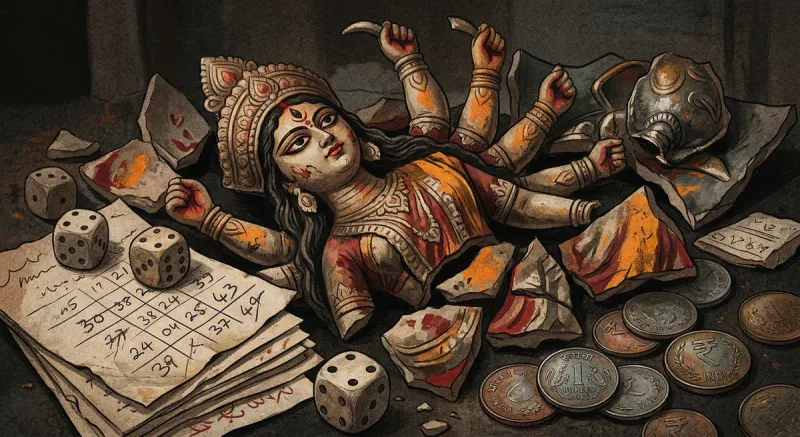
Durga Day: They Named an Illegal Gambling Market After a Goddess and Nobody Stopped Them
Writer
This article is for educational purposes only. We do not promote gambling.
Say the Name Out Loud
Durga. In Hinduism, she is the warrior goddess. The destroyer of evil. The protector of dharma. Temples across India are dedicated to her. Navratri — nine nights of worship — draws hundreds of millions of devotees. Her image represents power, righteousness, and divine justice.
Now open a Satta King website. Find "Durga Day" in the list of markets. Watch a sacred name sit between "Gali" and "Faridabad" in a menu of illegal gambling options.
That juxtaposition should make your stomach turn. It made mine turn. And I've been investigating Satta markets long enough to think I was past being shocked.
I spent several weeks looking into how and why gambling markets use religious names, with Durga Day as the case study. What I found goes beyond marketing. It's a deliberate, calculated strategy that exploits the deepest beliefs of hundreds of millions of people to normalize an illegal activity.
What Is Durga Day?
Durga Day is a Satta market — a daily single-number lottery in the Satta King ecosystem. It operates like all the others: one number, 00 to 99, declared once daily. Players bet through agents, WhatsApp groups, and online platforms. The house takes its cut. Most players lose.
The mechanics are identical to Gali, Desawar, or any other Satta King market. There is nothing special about the game itself. The only thing different is the name.
And the name is everything.
Why Religious Names Work
The use of religious names in illegal gambling is not random. It's a branding strategy that exploits several psychological mechanisms simultaneously.
Trust Transfer
Psychologists call it "halo effect" — when positive associations with one thing transfer to an unrelated thing. Professor Edward Thorndike first documented this in 1920. When a name carries positive connotations (divinity, power, protection), those connotations unconsciously transfer to whatever bears that name.
"Durga Day" borrows the trust and reverence that the name Durga commands. A player doesn't consciously think "this market is blessed by a goddess." But the subconscious association is there. The name feels safer, more legitimate, more trustworthy than it has any right to feel.
Superstitious Reinforcement
India is a deeply religious country. Superstition and faith are woven into daily life. Players who pray before betting — and many do — find it easier to rationalize their gambling when the market itself carries a divine name.
"Main Durga ji ka naam leke khelta hoon. Unka aashirwad hoga toh number aayega."
Translation: "I play taking Durga ji's name. If I have her blessing, the number will come."
That was said by a player in Agra. A man in his forties. He was completely sincere. He genuinely believed that a goddess's name on a gambling market meant something about his odds.
It doesn't. The name is a label chosen by criminals. It has no more spiritual significance than the brand name of a cigarette. But for this man, and millions like him, the association between divinity and gambling has been cemented by repetition.
Normalization Through Familiarity
When something carries a name you hear in temples, in prayers, in festivals — it can't be that bad, right? That's the unconscious logic. The name domesticates the activity. It takes something illegal, harmful, and exploitative and wraps it in a word that every Hindu family uses with love and devotion.
As we documented in our investigation of Morning Syndicate's brazen use of crime terminology, naming is never an accident in the Satta world. Every market name is chosen to accomplish something — to normalize, to attract, to disarm.
The Sacrilege Nobody Protests
Here's what baffles me. India is a country where religious sentiments are taken extremely seriously. Films have been protested for perceived disrespect to deities. Books have been banned. Political careers have been built on the promise of protecting religious sanctity.
Yet an illegal gambling market operates daily under the name of one of Hinduism's most revered goddesses, and there is near-total silence.
Why? Because the gambling operates underground. There's no storefront with "Durga Day" written in neon. There's no company to target. It exists in WhatsApp groups and Telegram channels and websites hosted on servers in jurisdictions that don't respond to Indian court orders.
You can't protest what you can't point to. And Durga Day, like all Satta markets, is designed to be unpointable. It exists everywhere and nowhere. It's on millions of phones and in no physical location.
Not Just Durga
Durga Day is not an isolated case. The Satta King ecosystem is littered with religious and culturally significant names. Shri Ganesh, Balaji, Kuber — gods and sacred figures repurposed as gambling brands.
Each name serves the same function: transfer trust, reinforce superstition, normalize the activity. The strategy works so well that new markets entering the ecosystem almost always choose culturally loaded names.
A retired advertising executive I spoke to — someone who spent 30 years building brands for legitimate companies — was appalled when I showed him the list of Satta market names.
"This is textbook brand parasitism. You take an established brand — and what's more established than a deity worshipped by hundreds of millions? — and you attach your product to it. No marketing budget required. The brand equity is pre-built. Centuries of it."
Brand parasitism. That's exactly what it is. Except the product being sold is financial ruin.
The Player Profile
Who plays Durga Day specifically? From my interviews, the name attracts a certain type of player — often older, more religious, more traditional. These are men who might hesitate to play a market called "Diamond" or "Star" but feel a strange comfort with "Durga Day."
A chai stall owner in Lucknow — let's call him Shivam — told me he chose Durga Day specifically because of the name.
"Bahut saare market hain. Main Durga Day isliye khelta hoon kyunki naam achha hai. Durga Maa ka naam hai. Lagta hai shubh hoga."
Translation: "There are many markets. I play Durga Day because the name is good. It's Durga Maa's name. It feels auspicious."
Feels auspicious. An illegal gambling market feels auspicious because of its name. That sentence encapsulates everything wrong with this naming strategy. It has successfully converted criminal activity into something that feels divinely endorsed.
Shivam has lost approximately Rs 2 lakh over three years. He still feels the name is auspicious.
The Damage to Faith
There's a less obvious victim here: faith itself.
When a person prays to Durga before placing a bet on Durga Day, and then loses — which they will, repeatedly — what happens to their relationship with their faith?
Some players externalize the loss: the goddess didn't help this time, maybe next time. But others internalize it: maybe I'm not worthy of divine help. Maybe the goddess is punishing me. This can lead to a toxic cycle where gambling failures become spiritual failures, deepening both the addiction and a crisis of faith.
Dr. Robert Ladouceur, a leading gambling researcher from Laval University in Quebec, has published on how superstitious beliefs reinforce gambling behavior. When players believe in supernatural influence on random outcomes, they gamble more and for longer, because every loss becomes a test of faith rather than evidence of bad odds.
Durga Day doesn't just exploit its players financially. It colonizes their spiritual life. It turns prayer into a betting ritual and faith into a coping mechanism for losses.
The Ripple Effect on Families
The religious name adds a complication to family dynamics. When a wife discovers her husband is losing money on Durga Day, the conversation is different from discovering he plays "Diamond Satta" or "Star Day."
"Woh kehta hai Durga Maa ka naam hai, kuch galat nahi hai. Main kya bolun? Main bhi Durga Maa ki bhakt hoon. Naam sun ke toh lagta hai theek hoga. Lekin paisa toh ja raha hai."
Translation: "He says it's Durga Maa's name, there's nothing wrong. What do I say? I'm also a devotee of Durga Maa. Hearing the name, it feels like it should be okay. But the money is going."
That was a woman in Kanpur. Her husband has been playing for two years. She finds it hard to object because the name creates a shield. How do you argue against something named after a goddess you both worship?
The name weaponizes faith within families. It turns a shared belief into a barrier to intervention.
Legal and Social Accountability
Under Indian law, gambling operations are illegal. But there's no specific law against using religious names for gambling markets. The Blasphemy provisions in the Indian Penal Code (Section 295A) criminalize deliberate acts intended to outrage religious feelings. But applying this to a market name that exists only in digital whispers is a legal stretch.
Social accountability is equally absent. Religious organizations, which are vocal about many forms of perceived disrespect, have not targeted Satta market names. This is partly because the markets operate underground and partly because awareness is low.
What You Can Do
If you play Durga Day — or any Satta market with a religious name — I want you to sit with this thought.
The people who named this market did not do it out of devotion. They did it because your devotion makes you easier to exploit. They chose Durga's name the way a con artist wears a suit — to look trustworthy. The suit doesn't make the person honest. The name doesn't make the market auspicious.
Every rupee you bet on Durga Day goes to operators who profit from your faith. They don't pray before declaring results. They don't fast during Navratri. They picked a name from a menu of options because it tested well with their target audience. You are the target audience.
Your faith is real. The market is a scam. These two things can coexist. Durga Maa doesn't live in a WhatsApp group that asks for Rs 500 bets. She lives in your prayers, your values, your actions. Don't let criminals rent her name to pick your pocket.
If you need to talk to someone, iCall (9152987821) and the Vandrevala Foundation helpline (1860-2662-345) are free and confidential. They understand the complexity of faith-based gambling. They won't judge your beliefs. They'll help you separate what's sacred from what's a scam.
Durga destroys evil. Gambling is not her instrument. It's the evil she would destroy. Remember that the next time someone sends you a "Durga Day tip" on WhatsApp.

Written by
Rustam AliWriter
Rustam Ali writes the way a good host pours tea—slow enough to savor, quick enough to keep the cup warm. Over fifteen years he’s shaped everything from long-form literary essays to tight, nervy copy for fintech start-ups, always hunting the phrase that makes a reader feel seen. He’s happiest when a sentence snaps shut like a well-made suitcase, and he still keeps a reporter’s notebook in his back pocket because stories have a habit of showing up uninvited.
View all postsYou might also like
Real Stories Market: असली कहानियों के नाम पर चल रहा सट्टा मटका का सबसे खतरनाक जाल — पूरी जानकारी और चेतावनी
9 मिनट का पाठ
newsMangal Night: Mars, Masculinity, and Midnight — The Market That Turns Astrological Fear Into Profit
9 min read
newsSuper Night: The After-Dark Sibling That Catches Daytime Losers in a 24-Hour Gambling Loop
9 min read