Gali Satta: The Back-Alley Market That Feeds on Delhi's Migrant Workers
Writer
This article is for educational purposes only. We do not promote gambling.
He Came to Delhi for Work. He Found Gali Satta Instead.
Bablu left his village in Bihar three years ago. He was 22. He had a plan: come to Delhi, drive an e-rickshaw, save Rs 5,000 a month, send it home. His mother needed surgery. His younger sister needed school fees.
Today, Bablu owes Rs 1.8 lakh to a moneylender in Uttam Nagar. He hasn't sent money home in four months. His mother's surgery is postponed indefinitely. His sister dropped out.
What happened? Gali Satta happened.
I spent three weeks in West Delhi's migrant worker colonies investigating this market. What I found was a gambling operation so deeply embedded in the daily life of migrant laborers that most people don't even think of it as gambling anymore. It's just part of the routine. Wake up, eat, work, bet, sleep. Repeat until the money runs out.
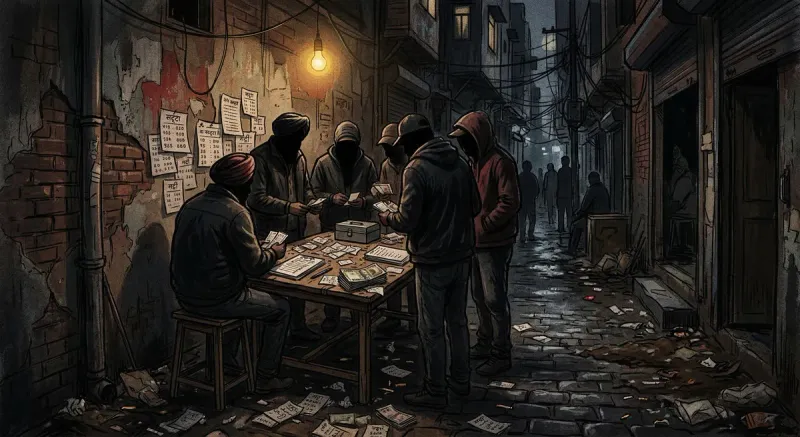
The name itself tells you everything. Gali. Lane. Alley. This isn't some glamorous casino operation. This is back-alley gambling in the most literal sense — numbers whispered in narrow lanes, bets placed at chai stalls, results checked on cracked phone screens in shared rooms where eight men sleep on the floor.
What Is Gali Satta?
Gali Satta is one of the most popular Satta Matka markets in North India. Unlike the Mumbai-originated Matka markets that built their reputation in the textile mill districts, Gali emerged from Delhi's dense urban fabric — the narrow lanes of Old Delhi, the migrant clusters in outer Delhi, the daily-wage economy of India's capital.
The market runs on a simple structure. A single number between 00 and 99 is declared as the result. Players bet on numbers, combinations, and variations. The payout ratios vary, but the house edge is massive — operators keep between 10% and 40% of all money wagered.
What makes Gali different from other markets is its geography. This is a Delhi market. It feeds on Delhi's unique demographic reality — a city where an estimated 30-40 lakh migrant workers live in informal settlements, earning daily wages, handling cash, and isolated from family support systems.
These workers are the fuel that keeps Gali Satta running.
Delhi's Migrant Worker Pipeline
Let me explain why Delhi is perfect hunting ground for a market like Gali Satta.
According to the Economic Survey of Delhi, the city receives migrants from across North India — Bihar, Uttar Pradesh, Madhya Pradesh, Rajasthan, Jharkhand. They come for construction work, driving, factory labor, domestic help, delivery services. The informal sector employs the vast majority.
These workers share certain characteristics that make them vulnerable. They earn daily or weekly in cash. They live in shared rooms with other men from their village. They're away from wives, parents, and the social structures that normally regulate behavior. They're lonely. They're stressed. And they have cash in their pockets with no one watching how they spend it.
Into this vacuum steps the Gali Satta agent.
A former agent I spoke to — let's call him Pintu — explained his territory. He operated in a migrant colony in Nangloi for five years.
"Mera area mein 200 se zyada Bihar ke ladke rehte hain. Sab log construction ya delivery ka kaam karte hain. Shaam ko thak ke aate hain, phone pe time paas karte hain. Main unko game dikhata hoon. Pehle Rs 50 se shuru karte hain. Phir Rs 100, Rs 200. Ek baar lag jaaye toh chhootata nahi."
Translation: "In my area, more than 200 guys from Bihar live. They all do construction or delivery work. They come home tired in the evening, pass time on their phones. I show them the game. They start with Rs 50. Then Rs 100, Rs 200. Once they're hooked, they can't let go."
Two hundred potential targets in one colony. One agent. Pintu told me he had about 60-70 regular players. His daily collection was Rs 8,000-15,000. His commission: 10%.
The Psychology of the Displaced
This is where Gali Satta gets truly insidious. It doesn't just exploit financial vulnerability. It exploits psychological displacement.
Dr. Nimesh Desai, former director of IHBAS (Institute of Human Behaviour and Allied Sciences) in Delhi, has written about the mental health challenges facing migrant workers. Social isolation, identity disruption, chronic stress, and lack of recreational outlets create what psychologists call a "vulnerability cluster" — multiple risk factors converging on the same person at the same time.
Gambling fills multiple psychological needs simultaneously for migrant workers. It provides social connection — you're now part of a group, the guys who play Gali. It provides excitement in an otherwise monotonous life. It provides hope — maybe tonight's number will change everything. And it provides an identity — you're not just another laborer, you're a player, someone who takes risks, someone who might win big.
All of these psychological rewards are real. The financial reward almost never is.
The Loneliness Factor
I spoke to a psychologist who works with migrant populations in Delhi — she asked not to be named. She described a pattern she sees repeatedly.
"These men are 20-35 years old. They left their families. Many are married but their wives and children are in the village. They work 10-12 hours. In the evening, they have nothing to do. No family, no entertainment, no social life. Gambling gives them something to talk about, something to look forward to. It's not about money at first. It's about belonging."
Belonging. That word stayed with me. Gali Satta sells belonging to people who have none. The price of that belonging is everything they earn.
The Numbers Don't Lie
India's illegal gambling market is estimated at Rs 10-15 lakh crore annually. Delhi, as the national capital and a major migrant hub, is one of the largest centers. Police records suggest that Gali and Desawar together account for a substantial portion of daily betting volume in North India.
Conservative estimates suggest Gali Satta processes several crore rupees daily across Delhi-NCR alone. Each day. Seven days a week.
At the individual level, the damage is devastating. A worker earning Rs 500-700 a day who bets Rs 100-200 daily is losing 15-30% of his income to gambling. Over a month, that's Rs 3,000-6,000 gone. Over a year, Rs 36,000-72,000. For someone sending money home to support a family, that's catastrophic.
Bablu, the e-rickshaw driver I mentioned at the start, told me his breakdown. He earns about Rs 800 on a good day. He started betting Rs 100 on Gali. Within two months, it was Rs 300-500 daily. He won a few times early on — Rs 4,000 once, Rs 2,500 another time. Those wins convinced him the system could be beaten.
"Jab jeeta toh laga ki isko samajh liya maine. Mujhe pata hai kaise khelna hai. Woh feeling bahut khatarnak hai."
Translation: "When I won, I felt like I'd figured it out. I know how to play. That feeling is very dangerous."
He was right. That feeling — the illusion of skill — is the most dangerous thing gambling can give you. Because Gali Satta has no skill component. The results are either random or fixed by operators. No amount of pattern-reading or number-tracking changes the odds. But early wins create the illusion that it does.
The Back-Alley Agent Network
Gali Satta's distribution network in Delhi is remarkable for how invisible it is. Unlike Mumbai's matka operations which historically had visible presence, Gali operates through a decentralized network of agents who blend perfectly into the urban fabric.
The chai stall owner who takes your order and your bet. The mobile recharge shop guy who tops up your phone and notes down your number. The auto driver who knows everyone at the stand and collects bets between rides. As we reported in our investigation of Morning Syndicate's organized crime structure, these networks run like professional operations with layers of command.
In the migrant colonies, agents are often from the same home state as their targets. A Bihar agent for Bihar workers. A UP agent for UP workers. Language, trust, shared identity — all weaponized for gambling collection.
"Apne gaon ka ladka hai, uska trust alag hota hai," one former player told me. "Your own village boy, you trust him differently."
That trust is the key that unlocks the wallet.
Digital Migration
Gali Satta has aggressively moved to digital platforms. WhatsApp groups, Telegram channels, and dedicated apps make betting frictionless. A migrant worker with a smartphone — and nearly all of them have one — can place a bet in 30 seconds via UPI.
The digital shift has also expanded the geographic reach. You don't need to be in a Delhi gali to play Gali Satta anymore. Workers in Gurgaon, Noida, Faridabad, even other states, can access Delhi-based agents through their phones. The back-alley went digital, and the alley now stretches across North India.
The Remittance Trap
Here's the most heartbreaking part of my investigation. Migrant workers gamble with money that was meant for their families back home.
The remittance cycle works like this. A worker earns Rs 15,000-20,000 a month. He's supposed to send Rs 8,000-10,000 home. Rent and food in Delhi take Rs 4,000-5,000. That leaves a small margin.
Gali Satta eats into the remittance first. Because the rent has to be paid — the landlord is here, in person, demanding. Food has to be bought — you can't work hungry. The family back home is a phone call away. Easy to delay. Easy to lie.
"Amma ko bolta hoon ki salary late aayi. Ya koi kaam nahi mila is hafte. Jhooth bolte bolte adat ho gayi."
Translation: "I tell my mother that the salary came late. Or that I didn't get work this week. Lying became a habit."
That was Bablu again. His voice broke when he said it. The guilt of lying to his mother is worse than the financial loss, he told me. But stopping feels impossible.
Families in villages across Bihar and UP are receiving less money. Some are receiving nothing. They don't know why. They think the city is expensive, that their son is working hard but prices are too high. They don't know about Gali Satta. They may never know.
Legal Blind Spots
Gali Satta is illegal under the Public Gambling Act of 1867 and the Delhi Prevention of Gambling Act, 1955. Delhi Police periodically conducts raids — you'll see news reports of small-time agents arrested with betting slips and a few thousand rupees.
But these raids are like removing a bucket of water from the ocean. The operators who run Gali Satta are never touched. The distributors who manage the agent networks are rarely identified. The arrests catch the bottom rung — the very people who are themselves often economically vulnerable.
Digital betting compounds the enforcement challenge. A WhatsApp message with a three-digit number is not evidence in any meaningful sense. UPI transfers look identical to legitimate personal transactions. The entire operation is designed to be invisible to the legal system.
Like the Prabhat market that preys on morning hope, Gali Satta has engineered itself to be legally untouchable while remaining socially pervasive.
The Compounding Damage
Money loss is just the visible layer. Beneath it, Gali Satta destroys in ways that don't show up in bank accounts.
Mental health deterioration. Migrant workers already face high rates of depression and anxiety. Gambling adds financial stress, shame, and secrecy on top of existing psychological burdens. The result is a mental health crisis that nobody is tracking because these men don't access formal healthcare.
Physical health suffers too. Workers who gamble heavily often skip meals to save betting money. Sleep is disrupted by late-night result checking and early-morning loss chasing. This is similar to the pattern we documented in Kalyan Night's exhaustion-based exploitation. Workplace injuries increase because you can't operate heavy machinery or drive safely on three hours of sleep and an empty stomach.
Social networks collapse. The same community bonds that drew a worker into Gali Satta — the shared culture, the village connections — become toxic when debts accumulate. Borrowing from roommates leads to conflicts. Trust erodes. The isolation that drove them to gambling in the first place becomes worse.
What You Can Do
If you're a migrant worker in Delhi and you're playing Gali Satta, I want to tell you something directly.
You came to this city to build something. For your family. For yourself. Gali Satta is taking what you came to build. Not dramatically, not all at once, but in Rs 100 and Rs 200 cuts every day. The math doesn't work. It never has. The house keeps 10-40% of everything wagered. Over months, you are guaranteed to lose more than you win.
The wins you remember? They're designed to keep you playing. The losses you forget? They're the actual business model.
One step: Tell one person. A friend from home. A family member on the phone. Anyone. Say the words out loud: "Main Gali Satta khelta hoon aur mera paisa doob raha hai." I play Gali Satta and I'm losing money. Saying it breaks the silence. Silence is what keeps the machine running.
You can call iCall at 9152987821 or the Vandrevala Foundation helpline at 1860-2662-345. Both are free, confidential, and available in Hindi. They won't judge you. They've heard it before. You're not the first person to call, and that itself should tell you something — this problem is bigger than you, and it's not your fault for getting caught in it.
Gali Satta operates in the back alleys because it can't survive in the open. It needs darkness, silence, and shame to function. The moment you bring it into the light — even to one person — you've taken something away from it.
Your family is waiting for the money you came here to earn. The lane runs in two directions. You can still walk out.

Written by
anukul royWriter
Anukul Roy still buys two newspapers every morning because he believes the smell of ink carries stories better than screens ever will. Over the past twelve years he’s turned that obsession into by-lined pieces for places like The Caravan and Wired India, profiling everyone from rooftop-farmers in Ranchi to blockchain librarians in Shillong. He writes tight, research-heavy narratives, then reads them aloud to his cat—if she purrs, he hits send. What keeps him at the desk is the moment a stranger says, “I never looked at it that way.”
View all postsYou might also like
Real Stories Market: असली कहानियों के नाम पर चल रहा सट्टा मटका का सबसे खतरनाक जाल — पूरी जानकारी और चेतावनी
9 मिनट का पाठ
newsMangal Night: Mars, Masculinity, and Midnight — The Market That Turns Astrological Fear Into Profit
9 min read
newsSuper Night: The After-Dark Sibling That Catches Daytime Losers in a 24-Hour Gambling Loop
9 min read