Morning Syndicate: They Put 'Organized Crime' Right in the Name and Nobody Blinked
Writer
This article is for educational purposes only. We do not promote gambling.
Read the Name Again. Slowly.
Morning Syndicate.
Let's pause on that second word. Syndicate. Say it out loud.
A syndicate is a group of people or organizations working together — usually for a purpose that isn't exactly legal. Drug syndicates. Crime syndicates. Smuggling syndicates. When you hear "syndicate" in a news headline, someone is getting arrested.
Yet here's a Satta Matka market that literally put the word in its name. Hung it up like a shop sign. And millions of people looked at it, shrugged, and placed their bets anyway.
That fact alone tells you everything about how deeply gambling has been normalized in parts of India. When organized crime wears a name tag and people still walk in the door, you know something has gone seriously wrong.
I spent weeks digging into Morning Syndicate — its structure, its agent network, its morning and night variants, and the psychology that lets people ignore a flashing red warning sign written in plain language. Here's what I found.
What Is a Syndicate, Really?
Before we go further, let's make sure we all understand what this word means. Because I think people hear "Morning Syndicate" and process it the way they process brand names — as a meaningless label. Like calling a shop "Lucky Store" or a restaurant "Paradise."
It's not meaningless.
The Oxford English Dictionary defines a syndicate as "a group of individuals or organizations combined to promote some common interest." That sounds harmless until you see how the word is actually used in the real world.
Crime syndicate. A mafia operation. Drug syndicate. An international narcotics network. Gambling syndicate. An organized betting operation run for profit.
In journalism, when we write about syndicates, we're writing about organized crime. Full stop. The word carries decades of association with illegal operations, money laundering, extortion, and exploitation.
Morning Syndicate didn't accidentally choose this name. The name is a statement. It says: we are organized, we are a network, and we operate on a scale that requires coordination. It's the most honest name in the Satta Matka world.
And somehow, that honesty hasn't scared anyone away.
The Scale of the Operation
India's illegal gambling industry moves an estimated ₹10-15 lakh crore annually. To put that in perspective, that's larger than the entire budget allocation for India's education sector. Satta Matka is one of the oldest pillars of this industry.
Morning Syndicate operates across multiple states. It has both morning and night variants — Morning Syndicate and Night Syndicate — creating a two-shift operation that mirrors legitimate businesses. Only this business extracts money from people who can't afford to lose it.
The player base is vast. Exact numbers are impossible because the entire operation is illegal, but anti-gambling researchers estimate that individual popular Matka markets attract lakhs of daily players. Morning Syndicate, with its established brand and wide agent network, is among the more popular ones.
The daily money pool for a market like this can run into crores. Every day. Seven days a week. No holidays. No weekends off. The syndicate never sleeps, even if it does have "morning" in its name.
The Structure Behind the Friendly WhatsApp Group
This is where it gets interesting. And dark.
From the outside, Morning Syndicate looks casual. A WhatsApp group here, a Telegram channel there. Your neighborhood bookie is a friendly guy who knows your name, asks about your kids, gives you "tips" with a wink.
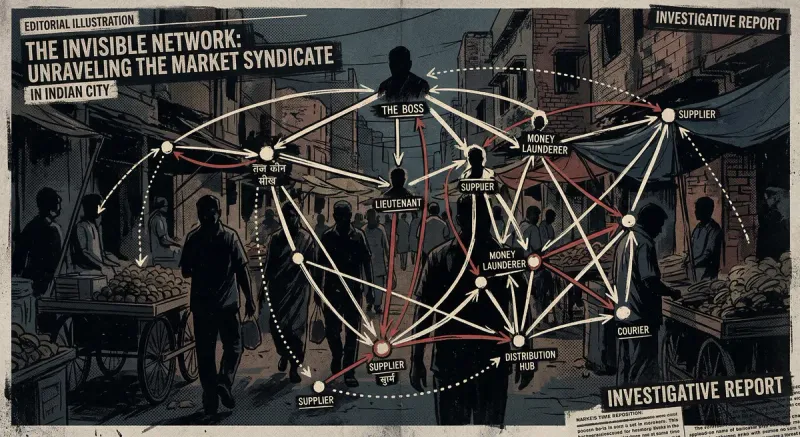
Behind that friendly surface is a highly organized criminal enterprise. Let me walk you through the layers.
Layer 1: The Operators
At the top sit the operators — sometimes called "matka kings" or organizers. These are the people who actually run the market. They decide results in some cases. They set the payout ratios. They control the flow of money. They are invisible to regular players.
These operators typically have no direct contact with bettors. They communicate through a chain of command. Think of them as the CEO of a company you'll never meet. Except this company's product is financial ruin.
Layer 2: The Distributors
Below the operators are distributors or area managers. These people manage agents across a geographic region — a city, a district, sometimes an entire state. They collect the aggregated bets from agents, pass up the money, and handle the distribution of winnings.
Distributors handle large sums of cash daily. They need to be trusted by the operators, which usually means they've been in the network for years. Some distributors manage 50-100 agents each.
Layer 3: The Agents
These are the boots on the ground. The people you actually interact with. Your local bookie. The guy at the pan shop. The contact in your WhatsApp group.
Agents collect bets from individual players and pass them up to distributors. They earn commissions — typically 5-10% of every bet they collect. A busy agent collecting ₹10,000-20,000 in daily bets earns ₹500-2,000 per day in commissions. For many, this is their primary income.
I spoke with a former Morning Syndicate agent — let's call him Anil. He operated in a mid-sized city for three years.
"Mere paas 80-90 regular players the. Har subah 6 baje se phone aane lagte the. 'Anil bhai, aaj 3-7-2 lagao, ₹500.' Main sab note karta tha, distributor ko bhejta tha. Shaam ko result aata tha, main settlement karta tha."
Translation: "I had 80-90 regular players. Every morning from 6 AM, calls would start coming. 'Anil bhai, put 3-7-2 for ₹500.' I'd note everything, send it to the distributor. Evening, results would come, I'd do settlements."
80-90 regular players. One agent. In one neighborhood. In one city. Multiply that across India and the scale becomes clear.
Layer 4: The Players
At the bottom of the pyramid — always at the bottom — are the players. They put money in. Most of them don't get money back. They are the product. The raw material. The fuel that keeps the syndicate running.
Every pyramid needs a base. In Morning Syndicate, that base is made of ordinary people betting money they need for groceries.
How Normalization Makes Red Flags Invisible
So why do people ignore the name? Why does "syndicate" — a word that should trigger alarm bells — get treated like wallpaper?
The answer is normalization. And it works like this.
Step 1: Everyone Around You Does It
Social proof is one of the most powerful forces in human behavior. When everyone in your auto stand plays Morning Syndicate, it doesn't feel criminal. It feels normal. Like drinking chai. Like checking cricket scores.
"Sab log khelthe hain" — everyone plays. I heard this phrase from almost every former player I interviewed. It was their explanation. Their justification. Their shield against the voice in their head saying this might be wrong.
When a behavior is widespread, the brain stops flagging it as risky. This is a well-documented psychological phenomenon. Researchers call it "descriptive norm influence." If lots of people do something, our brain assumes it must be okay.
Morning Syndicate has achieved what every illegal operation dreams of: becoming so common that it feels legal.
Step 2: The Language Gets Softened
Nobody calls it gambling. They call it "khelna" — playing. Like a game. Like cricket or carrom. "Main matka khelta hoon" sounds harmless. "I play matka." Play. Fun. Innocent.
Nobody calls the agent a bookie. He's "bhai" — brother. "Anil bhai." He's family. He's a friend. He's definitely not a foot soldier in an organized crime syndicate. Even though that's exactly what he is.
Nobody says "I lost money gambling." They say "aaj number nahi aaya" — today the number didn't come. As if the number has its own will. As if losing was bad luck rather than mathematical certainty.
Language is a powerful tool. Morning Syndicate benefits from a vocabulary that has been sanded down over decades until all the sharp edges are gone. The danger is hidden behind soft words.
Step 3: Small Amounts Feel Harmless
"It's just ₹100." "I only play small." "It's pocket money, nothing serious."
This is how it starts. And for the syndicate, small bets are the business model. They don't need whales dropping lakhs. They need thousands of small fish putting in ₹100-500 every day.
₹100 per day is ₹3,000 per month. ₹36,000 per year. For a daily wage worker earning ₹300-500 a day, that's one to three months of income. Gone. Over a year. In ₹100 increments that felt like nothing.
Death by a thousand cuts. Each cut is tiny. The bleeding is catastrophic.
Morning and Night: The Double Shift
Morning Syndicate has a night variant too. Night Syndicate. Same operators. Same structure. Same agents in many cases. Different time slot.
This creates the same destructive day-night cycle seen in other Matka markets. Lose in the morning, chase at night. Lose at night, try to recover in the morning.
But with Morning Syndicate, there's an added element. The brand carries across both shifts. You trust the Morning Syndicate agent because you've known him for months. When he says, "Raat wala bhi khelo, achha number hai" — play the night one too, good number — you listen. Because he's bhai. He's your guy.
He's also earning double commission by getting you to play both shifts. But that part stays unsaid.
The WhatsApp Machine
Digital transformation has supercharged the syndicate. Let me show you what a typical Morning Syndicate WhatsApp group looks like.
5:30 AM — Group admin posts: "Good morning! Aaj ka game ready hai. Book karo jaldi."
5:45 AM — Tips start flowing. "Strong number: 4-6-8. Source pakka." These tips are worthless. Nobody has a "source." But they create urgency and FOMO.
6:00-7:30 AM — Players send their bets via private messages to the agent. "Bhai, 2-5-7 laga do, ₹200."
Result time — Admin posts results. Winners are celebrated publicly. "Ramesh bhai ne ₹5,000 jeete! Congratulations!" Losers are never mentioned. This creates a distorted picture where it seems like everyone is winning.
This is a classic manipulation technique. Publicize wins, hide losses. Over time, group members develop a skewed perception of how often people actually win. They think winning is common. It's not. But the WhatsApp group makes it look like it is.
Some groups even have "proof" — screenshots of payment confirmations, photos of cash. These can be real (some people do win sometimes — that's how gambling hooks work) or fabricated. Either way, they serve the same purpose: keeping hope alive.
The Money Trail
Where does the money go? This was the hardest part of my investigation to crack, because the entire operation is designed to be opaque.
But here's what former insiders told me.
Total bets collected go to the distributor. The distributor keeps a cut and passes the rest up to operators. Winnings are paid out — but the total payouts are always significantly less than total bets collected. The difference is profit.
That profit funds the network. Agent commissions. Distributor salaries. Protection money to ensure the operation isn't shut down. Sometimes, investments in other illegal activities.
Some of the money enters the legitimate economy through shell businesses, real estate purchases, and cash-intensive enterprises. This is textbook money laundering. The morning bets placed by auto drivers and vegetable vendors get cleaned and converted into assets that the operators enjoy.
Your ₹200 bet might end up as a tile on someone's farmhouse floor. That's the reality.
Why the Name Should Matter
I want to come back to the name one more time.
Imagine a restaurant called "Food Poisoning Palace." Would you eat there? Imagine a taxi service called "Accident Express." Would you ride?
Of course not. The name would warn you away.
Morning Syndicate literally has a crime term in its name. Syndicate. Organized crime. Criminal network. The name is telling you what it is. Right there. No code. No hidden meaning.
And people play anyway.
That's not because they're stupid. These are hardworking, intelligent people. It's because the normalization machine has done its job so well that the word "syndicate" has been stripped of its meaning in this context. It's become just a brand name. Two words on a WhatsApp group title.
But the word still means what it means. Behind the friendly agent, behind the morning tips, behind the WhatsApp congratulations — there is an organized criminal network. It has hierarchy. It has territory. It has revenue. It has methods for avoiding law enforcement.
It is, in every sense of the word, a syndicate.
The Law and Its Limits
All Satta Matka operations violate the Public Gambling Act of 1867. State laws add additional prohibitions. Running a gambling syndicate can attract serious criminal charges.
But prosecution is rare. The digital shift has made evidence gathering difficult. WhatsApp messages disappear. UPI transactions look like personal transfers. Agents operate from their phones while doing legitimate jobs — the auto driver who's also a bookie, the shopkeeper who's also an agent.
When arrests do happen, they typically catch the bottom of the chain. Small agents. Individual players. The operators remain untouched. The distributors keep working. Within days, a new agent fills the gap and the operation continues.
This is the advantage of being a syndicate. No single point of failure. Remove one node and the network routes around it. It's resilient by design.
What Happens to the Players
The end of this story is always the same. I've heard it dozens of times now, and it never gets easier.
Money runs out. Savings are depleted. Borrowing begins — first from family, then from friends, then from moneylenders charging predatory interest. Debt accumulates. Work suffers because the mind is always on the next bet. Relationships fracture. Health deteriorates from stress and anxiety.
Some players hit rock bottom and stop. They're the lucky ones. Others spiral further — into depression, into deeper debt, into isolation.
The syndicate doesn't care. You are a revenue unit. When you run dry, there's someone else ready to take your place. The morning WhatsApp group doesn't notice when a name goes silent. There's always a new member ready to join.
If You're In This
Look at the name of the game you're playing. Really look at it. Morning Syndicate. Night Syndicate.
They told you what they are. Right there in the name.
A syndicate is not your friend. An agent is not your "bhai." A WhatsApp group is not a community. It's a sales channel for an illegal operation that profits from your losses.
Every ₹100 you send is working capital for a criminal enterprise. That's not an exaggeration. That's a fact.
Getting out isn't easy. The social pressure is real — your friends play, your colleagues play, the agent will message asking where you've been. But the math is real too. And the math says you lose. Always, eventually, you lose.
Delete the group. Block the agent. Tell one person you trust that you want to stop. Just one person. That's enough to start.
iCall (9152987821) and Vandrevala Foundation (1860-2662-345) are available if you need professional support. Free. Confidential. No lectures.
Morning Syndicate told you what it was from day one. It put the truth right there in the name. Now that you've read it — really read it — you can't unsee it.
The question is: what are you going to do about it?

Written by
anil kumar jainWriter
Anil Kumar Jain writes the way a good host tells stories—leaning in, remembering everyone’s name, and pausing at the exact moment you need to breathe. For twenty years he has turned technical journals, forgotten ledgers, and overheard train chatter into narratives that executives quote and grandkids dog-ear. He still keeps a reporter’s notebook in the breast pocket of every jacket, because the best plot twist might be sitting at the next red light. What keeps him typing is simple: finding the ordinary sentence that makes a stranger feel seen.
View all postsYou might also like
Real Stories Market: असली कहानियों के नाम पर चल रहा सट्टा मटका का सबसे खतरनाक जाल — पूरी जानकारी और चेतावनी
9 मिनट का पाठ
newsMangal Night: Mars, Masculinity, and Midnight — The Market That Turns Astrological Fear Into Profit
9 min read
newsSuper Night: The After-Dark Sibling That Catches Daytime Losers in a 24-Hour Gambling Loop
9 min read